Study Spanish Trail Learn Spanish in South America



LEARN SPANISH IN BOLIVIA: Top Schools & Travel Guide
Travel to Bolivia
Bolivia is a place that sticks with you - sometimes literally (hello, salt flats mud!). There's not too many places to learn Spanish in Bolivia, but we got you covered.
From its jaw-dropping altitudes to landscapes that look like they’ve been plucked from another planet, this country will challenge you, surprise you, and totally win you over. Sure, the thin air might leave you breathless, but trust me, it’s worth it.
Start your journey in La Paz, a city so high up it feels like it’s touching the clouds. Wander through its maze of streets, where you’ll bump into witches selling spells and shamans offering blessings. Feeling a little adventurous? Head to Torotoro National Park and go on a treasure hunt for dinosaur footprints -because who doesn’t want to pretend they’re in Jurassic Park?
Bolivia is full of show-stopping sights, like the neon-colored Laguna Colorada and Laguna Verde, best explored on a 3-day Uyuni Salt Flats tour. Speaking of Uyuni, don’t miss the chance to snap those crazy perspective photos. Yes, you too can look like you’re holding your friend in the palm of your hand.
Wine lovers, you’re in for a treat. Tarija, Bolivia’s hidden gem, is home to the world’s highest vineyards. And if you’re struggling with the altitude, chew on some coca leaves - it’s a local hack that works wonders.
For a slower pace, head to Sucre, where you can soak up the relaxed vibes and maybe pick up some Spanish skills. Or, if you’re feeling daring, gear up for Death Road, where biking down the world’s most dangerous highway is an experience you’ll never forget.
Bolivia isn’t just a destination - it’s an adventure waiting to happen. From ancient ruins and indigenous traditions to surreal desert landscapes, this is a place that doesn’t just invite exploration; it demands it.
Pack your curiosity, and get ready to fall head over heels for Bolivia.
Best Cities to Learn Spanish in Bolivia

La Paz
Studying in La Paz is a high-altitude, high-energy experience where modern urban life meets deep-rooted Andean traditions. As a student, your daily commute might involve riding the world’s most extensive cable car network, providing breathtaking views of the sprawling canyon and snow-capped Mount Illimani. Life outside the classroom is a sensory adventure: you can browse the mystical Witches' Market in the morning, grab a traditional salteña for lunch, and spend your evenings in the lively bars of the Sopocachi neighborhood. It is a city that requires independence and an adventurous spirit, perfect for students who want to be at the heart of Bolivia’s political and cultural action.
Sucre
Commonly known as the "White City," Sucre offers a relaxed, academic atmosphere that makes it a popular hub for Spanish learners in South America. Student life here follows a gentle, sun-drenched routine centered around the historic Plaza 25 de Mayo, where you'll find classmates gathering at open-air cafés to review grammar over a coffee. Because the city is compact and affordable, you can easily walk between colonial heritage sites, vibrant food markets, and student-favorite bars like Joy Ride. Weekends are often spent exploring local indigenous markets or joining the "Wallyball" (indoor volleyball) games that have become a staple social activity for the international student community.Beyond the classroom and the cozy cafés of Sucre or La Paz, Bolivia is a country of staggering natural contrasts waiting to be explored. From the surreal, mirror-like expanse of the Uyuni Salt Flats to the lush biodiversity of the Amazon basin, the 'trail' through Bolivia offers some of the most rewarding travel experiences in the world.
To help you plan your journey between lessons, here are our top recommendations for exploring the heart of the Andes.
What to See & Do While Studying in Bolivia
15 Incredible Reasons You must visit1. La Paz: Living the High Life in the Andes
At 11,400 feet above sea level, La Paz is one of the highest cities in the world, and it’ll certainly leave you breathless. The narrow crowded streets are dotted with stalls selling trinkets, crumbling colonial churches, little plazas, and old palaces filled with artifacts & everywhere you look, the red roofs rise upward into the mountains. More modern attractions include rappelling down the side of an office building, wandering past San Pedro prison, (read ‘Marching Powder’), and riding above the city on the teleférico for jaw-dropping panoramic views.

2. La Paz: Exploring the Witches' Market
Despite the size of La Paz, the city is most famed for a cluster of streets known as the Witches’ Market.
Here, you’ll find talismans to ward off evil and impotence, spells and potions for falling in love, and winning the lottery - and there’s a fair few llama fetuses on offer too, which are traditionally buried under the foundations of new houses to bless the family living there. It’s not recommended to buy into the market’s magical side, but it’s certainly an experience not to be missed.

3. Death Road: Cycling the World's Most Dangerous Road
Winding through the steep Bolivian mountains is a route known by locals as Yungas Road - but to visiting tourists and bike tour companies, it’s called ‘Death Road’.
This downhill track, which starts high up in the Andes and ends in the jungle, combines incredible scenery with a sheer drop mere feet from your bike’s wheels, so hang onto your handlebars and feel the adrenaline rush of mountain biking down the world’s most dangerous road. Death Road can be visited on an organized day trip from La Paz.
4. Sucre: Learn Spanish in the White City
Bolivia’s white city of Sucre is laid back, chilled, and filled with coffee shops, cafés and vegetarian-friendly restaurants; perfect for relaxing.
The warm, spring-like climate and its good safety levels make Sucre a perfect spot to study Spanish in Bolivia. When you’re not studying, check out the Folklore Museum and the General Cemetery for an insight into local Bolivian customs, and don’t miss the walk up to La Recoleta for fantastic views across the city.

5. Cochabamba: Bolivia's Gastronomic Capital
Cochabamba, Bolivia’s gastronomic capital, is perfect for diving into local cuisine. Move beyond fried chicken and typical set menus to explore street food stalls offering deep-fried tukumanas with dipping sauces, savory salteñas, and rellenos filled with mashed potato, vegetables or meat.
For drinks, try the warm purple maize drink api morado, or mocochinchi, made with dehydrated peaches in cinnamon water. Bolivia’s iconic chicha, a maize-based drink is often served in a shared pitcher. Cheers!

6. Tarija: High-Altitude Wine & Vineyards
In the south of Bolivia is the country’s wine capital of Tarija where the majority of Bolivia’s grapes are grown and harvested.
Tarija is a laid back town with palm tree-lined streets and, as you might imagine, the focus of life here is centered around wine; visiting wineries, touring small family-run vineyards and taste-testing the local specialties. Sit out at one of Tarija’s plazas with a good, cheap bottle of red and indulge in some people watching.

7. Coca Culture: Traditional Leaves & Altitude Relief
It may look a little suspicious at first, but the act of chewing coca leaves is not about drugs, it’s about Bolivian tradition. These indigenous leaves have been used for centuries - both by chewing and by brewing in tea - to act as a mild stimulant, and they’re often present in sacred ceremonies. Most importantly for visitors, chewing coca will help you adjust to the altitude, as well as provide you with increased energy and improved digestion. Check out the Coca Museum in La Paz for a more in depth look at history and its effect on Bolivian culture.

8. Torotoro: Hunting for Dinosaur Footprints
In the mood for some pre-historic history? Look no further than Torotoro National Park, which is practically stuffed to the fossilized gills with ancient bones, cave paintings and dinosaur footprints.
It’s also an outdoor adventurer’s playground with canyons, waterfalls and at least 40 different caves to explore - like Caverna Umajalanta, which stretches over 300 feet below sea level and is one of the longest and deepest caves in the country. Torotoro is a four-hour drive from Cochabamba.

9. Mount Chacaltaya: 360-Degree Andean Views
Just a few hours’ drive from la Paz is Mount Chacaltaya with 360-degree panoramic views of all the peaks of the surrounding mountains including the city of La Paz in the distance.
At around 17,000, a little abandoned building marks the spot where the world’s highest ski resort once stood; it’s only a few hundred meters from the resort to the snow-covered peak of Chacaltaya but it will take a surprisingly long time thanks to the air being so thin.
10. Eduardo Avaroa: Surreal Landscapes & Flamingos
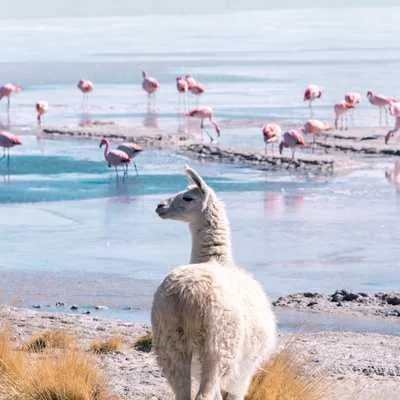
The landscapes of southern Bolivia are truly extraordinary, like something out of a science fiction movie: think vast swathes of emptiness dotted with herds of llamas, suddenly punctuated by a bright green lake flanked by even brighter pink flamingos, or volcanic rock formations rising out of the dust.
The only way to see the park is through an organized package tour, usually on route to the Salt Flats.

11. Salar de Uyuni: The World’s Largest Salt Flats
At over 4,000 feet above sea level, the Salt Flats at Uyuni are all that remain of a dried-out prehistoric lake bed - but it’s still the largest salt flat in the world. Uyuni is Bolivia’s biggest tourist attraction and thousands of perspective-skewing photos have been taken on the glimmering white salt plains, complete with pools of water reflecting the cloud-filled skies during the wet season (January to March). Make sure your itinerary includes a night spent in one of the nearby hotels, which are made entirely of salt!

12. Uyuni: The Spooky Abandoned Train Cemetery
At the start or end of your Salt Flats tour, you’ll pass through the tiny town of Uyuni - and under 2 miles away is a place where old locomotives come to die.
The train cemetery, here since the 1940s when the Bolivian mining industry declined, is an urban explorer’s heaven: dozens of abandoned trains, stripped of their most useful parts and left to rust in the ever-blowing winds filled with salt; creepy in the extreme.

13. Lake Titicaca: The World's Highest Navigable Lake
After spending time in Bolivia’s congested cities, Lake Titicaca is the perfect respite. It’s surreal to see the lake’s bright blue water with snow-covered mountain peaks on the horizon; Titicaca sits at over 12,000 feet above sea level, making it the world’s highest navigable lake.
Lakeside is the small town of Copacabana (not to be confused with Brazil’s more bustling beach), a sleepy place that’s a great base to explore the surroundings on foot, by rented bike or on a boat tour around the lake.

14. Isla del Sol: Ancient Inca Ruins & Sacred History
One of the largest islands of Lake Titicaca is Isla del Sol, a rocky piece of land just under 10 miles long. The Incas believed that their sun god was born there so the island is littered with almost two hundred 15th century Inca ruins.
The island has no paved roads or cars, meaning hikers can walk the length of the island along the dirt paths in peace, stopping off at one of the island’s family-run guesthouses when the sun goes down.

15. Potosí: Silver Mines & Colonial History
Famous for the silver ore discovered in Cerro Rico during the 16th century, Potosí is now known for its still-active mines, which tragically claim many miners’ lives.
Visitors can explore the mining tunnels or visit the Casa Nacional de Moneda, once Bolivia's royal mint, to learn about the city’s rich history. Wander Potosí’s steep streets, lined with 16th-century colonial architecture, at over 13,000 feet above sea level, this UNESCO-protected city is among the world's highest.
Bolivia Travel Itineraries for Spanish Language Students
4 Customized Routes to travel and learn Spanish in BoliviaWhether you have a couple of weeks or a couple of months to travel in Bolivia, here are some suggested itineraries for your trip as well as some helpful travel advice.
1 - Rapido Travel

A speedy circular route around Bolivia could look something like this (saving Death Road for your final return to La Paz, just in case you take a tumble):
La Paz - Salt Flats (trip to train cemetery) - Potosí - Sucre - Lake Titicaca (trip to Isla del Sol) - return to La Paz (side trip to Death Road)
Recommended
Spanish Schools
Here's our pick for the best Spanish School in La Paz & Sucre, Bolivia.
2 - Tranquilo Travel

It makes sense to travel slowly in Bolivia. If you have the time to take things easy, an itinerary like this one could be right up your street. This route works if you’re moving through South America, from the border with Peru and down towards Chile/Argentina.
La Paz (side trips to Death Road, Mount Chacaltaya, Lake Titicaca and Isla del Sol) - Cochabamba - Torotoro Park - Sucre - Potosí - Tarija - Uyuni (trip to train cemetery) - Salt Flats
Recommended
Spanish Schools
Here's our pick for the best Spanish Schools in La Paz & Sucre, Bolivia.
3 - For adventurers

Hiking, biking, and glacier climbing: despite the slow pace of life that Bolivia seems to have at first glance, adrenaline rushes are actually everywhere. You just need to know where to look.
Lake Titicaca (for hiking) - Death Road (for cycling) - Mount Chacaltaya (for climbing) - Torotoro Park (for hiking, climbing and caving) - Salt Flats (4x4 riding)
Recommended
Spanish Schools
Here's our pick for the best Spanish Schools in La Paz & Sucre, Bolivia.
4 - For Cultural Seekers

Spirituality abounds in Bolivia. Whether it’s the mysteries of shamanism, the fascinating indigenous cultures like the Quechua and Aymara people, or simply the heady altitude, there’s no doubt that the country feels entirely otherworldly. This itinerary traces all the most interesting cultural spots in the country.
Lake Titicaca - Isla del Sol - La Paz (for the witches market) - Torotoro Park - Sucre (for cultural museums) - Potosí (for mining history)
Recommended
Spanish Schools
Here's our pick for the best Spanish Schools in La Paz & Sucre, Bolivia.
Essential Travel Tips for Your Bolivia Trip
Practical Info for Students & TravelersAcclimate to High Altitude
Many Bolivian cities, including La Paz and Potosí, are at high altitudes. To avoid altitude sickness, take it slow upon arrival, stay hydrated, and consider remedies like coca tea or tablets. Plan a day or two for acclimatization before engaging in strenuous activities, such as hiking or mountain climbing.Cultural Etiquette & Language
Bolivians are generally reserved but friendly. Greeting people with a simple handshake and saying "buenos días" (good morning) or "buenas tardes" (good afternoon) is appreciated. Spanish is widely spoken, but indigenous languages like Quechua and Aymara are also common. Learn some basic Bolivian Spanish phrases to greatly enhance your experience.Transportation & Getting Around
Bolivia has affordable but basic public transportation options, including buses and minibusses. For more comfort on long-distance journeys, choose tourist or semi-cama (reclining seat) buses. In cities like La Paz, the cable car system ("Mi Teleférico") is a unique and efficient way to navigate the city while enjoying stunning views.What to Pack & Weather Considerations
Bolivia’s weather varies by region and altitude. Pack layers for the Andean highlands, where temperatures can drop significantly at night. For jungle regions like the Amazon, bring lightweight clothing, insect repellent, and waterproof gear. Comfortable walking shoes are a must for exploring sites like the Uyuni Salt Flats or trekking in the Andes. Always carry some toilet paper and bottled water with you, just in case.Where to explore after Bolivia? Visit our comprehensive itineraries and country guides!
1, 3 & 6 MonthItineraries
Learn Spanish in these 8 Countries


